


Welcome back to The i-Manu Script — where we pretend to be serious newsletter writers but are actually chronicling our obsession with all things manufacturing and infra (with a bias for R&D and some heavy sweating over valuation spreadsheets)
This July edition comes at a time when India’s PMI just hit a 17-year high. If this were the Sensex, Twitter would’ve broken. But no, it’s manufacturing — so everyone just slow clapped and moved on. Meanwhile, deep in Pune, IndoSpace is building logistics mega parks, Tata and Bosch are joining chip forces, and someone finally gave Godrej Aerospace the props they deserve.
We also continue our adventures in the “Deeptech but not a science experiment” zone — funding startups that have crossed the valley of death and are now sweating it out on factory floors. Some of these names will either be future household names or VC cautionary tales. Our job is to bet wisely and tell the tale either way.
We wrap with a sector deep dive into the Rare Earth Reality. You know, the boring-sounding metals that actually decide whether your EV moves, your windmill spins, and your missile hits. Spoiler: China’s got it, we want it, and the world’s looking for a Plan B (our portco is ahead of the game here!)
India Macros & Strategic Signals
• India’s manufacturing PMI hits 17-year high at 58.5 in July 2025, with private sector activity surging as new order inflows accelerate. This marks the strongest manufacturing performance since 2008, driven by both domestic demand and export orders, though input cost pressures are intensifying across supply chains. (Link)
• Tata Electronics partners with Bosch for semiconductor manufacturing through a joint venture that will establish India’s first automotive chip assembly and testing facility in Karnataka. The partnership combines Tata’s local manufacturing expertise with Bosch’s semiconductor know-how, targeting the growing domestic auto electronics market valued at $8.5B annually. (Link)
• IndoSpace, India’s largest industrial real estate platform, deploys ₹1,037 crore to develop a 188-acre logistics park in Pune’s Chakan region. The warehousing and industrial park developer, backed by GIC and Everstone, is expanding its eighth facility in Pune to serve automotive and consumer goods manufacturers establishing operations in the manufacturing belt. (Link)
• Godrej Aerospace secures Pratt & Whitney manufacturing contract for complex aircraft engine components, marking a significant step in India’s high-precision aerospace manufacturing capabilities. The deal positions Indian suppliers to capture a larger share of the global aerospace supply chain as geopolitical tensions reshape sourcing strategies. (Link)
• Rajoo Engineering raises $18.6M in post-IPO funding from Morgan Stanley and HDFC Bank, with proceeds earmarked for expanding plastic processing machinery production. The funding comes as the packaging sector grows at 12% CAGR, driven by e-commerce and food processing demand. (Link)
India Deal Roundup: Startups in Motion
OmSpace Rocket and Exploration • $3M Pre-Seed • Family offices and angel investors
Spacetech startup developing small satellite launch capabilities and space exploration technologies. (Link)
Unibose Technology • ₹5.5 crore Pre-Series A • Undisclosed investors
Chennai-based robotics startup building solutions for hazardous and confined industrial environments. (Link)
Green Aero • $1.6M Series A • pi Ventures
Next-generation aero engine developer focused on defence applications and hydrogen-powered civil aviation. (Link)
Serendipity Space • Pre-seed funding • Campus Fund
Deep-tech startup developing microgravity-enabled drug manufacturing through proprietary satellite platform ‘Alchemy’. (Link)
Netra Semiconductor • ₹107 crore Series A • Zoho Corporation, Unicorn India Ventures, Speciale Invest
Kerala-based fabless semiconductor startup building edge AI chipsets for automotive, robotics, and industrial applications. (Link)
AuraML • $1M Pre-Seed • Turbostart, DeVC, GSF Accelerator, Indian Angel Network
Deeptech startup building AI-powered solutions for industrial automation and machine learning applications. (Link)
Global Deal Roundup: Manufacturing, DeepTech & Industrial Innovation
Nuclear/Fusion
Commonwealth Fusion Systems from Cambridge, MA raised an undisclosed amount (believed to be around $1.8B) from Google. The startup develops compact fusion reactors for commercial fusion power generation. (Link)
Steady Energy based in Helsinki, has raised €32 million to develop the world’s first commercial small modular nuclear heating reactor. Earlier, it secured €10 million from investors including Local Tapiola, Tesi, Move Energy, Valo Ventures, and 92 Capital. (Link)
Semiconductors & AI Chips
Arago from Paris raised $26M seed funding from Earlybird, Protagonist, and Visionaries Tomorrow. The startup develops photonic AI chips designed to cut energy use by a factor of ten. (Link)
xLight from Palo Alto raised $40M Series B led by Playground Global and Boardman Bay Capital Management. The company builds lasers for the semiconductor manufacturing industry. (Link)
Advanced Materials & Manufacturing
Ionic Mineral Technologies raised $29M Series B funding. The company manufactures nano silicon anode powders, which are used to enhance the performance, charging speed and range of lithium-ion batteries. (Link)
Hertha Metals raised $17M from Khosla Ventures and Pear VC. The company’s single step technology enables cheaper, efficient and abundant production of steel for the industry and high purity iron for rare earth magnets. (Link)
Robotics & AI Infrastructure
Genesis AI from Paris and Palo Alto raised $105M seed funding co-led by Eclipse and Khosla Ventures, with participation from Bpifrance, HSG, and Eric Schmidt. The startup builds universal AI models enabling different robots to perform real-world tasks. (Link)
Civ Robotics from San Francisco raised $7.5M Series A led by AlleyCorp, with Bobcat Company and ff Venture Capital participating. The company makes autonomous surveying robots and construction material deployment machines. (Link)
Augmentus from Singapore raised $11M Series A+ led by Woori Ventures, with EDBI, Sierra Ventures, and Cocoon Capital participating. The startup designs no-code software for industrial robot programming. (Link)
Energy & Clean Tech
Tulum Energy from Mexico City raised $27M seed funding co-led by TDK Ventures and CDP Venture Capital. The startup produces hydrogen and solid carbon from methane using electric arc furnaces without CO₂ emissions. (Link)
Amogy from NYC raised $23M led by Korea Development Bank and KDB Silicon Valley LLC, with participation from Bon Angels Venture Partners. The company provides ammonia-to-power solutions for clean energy applications. (Link)
Sector Deep Dive: The Rare Earth Reality
The Metals Powering the Modern World
Rare earth elements (REEs), a group of 17 metallic elements including neodymium, dysprosium, and terbium that are the invisible scaffolding of today’s high-tech economy. These metals are essential to permanent magnets used in electric vehicle motors, wind turbines, advanced military systems, and green hydrogen technologies.
Despite their name, these materials are not geologically scarce. The challenge lies in separating, refining, and processing them. It’s a chemical and environmental maze that has created a global chokehold in the value chain.
The Processing Challenge
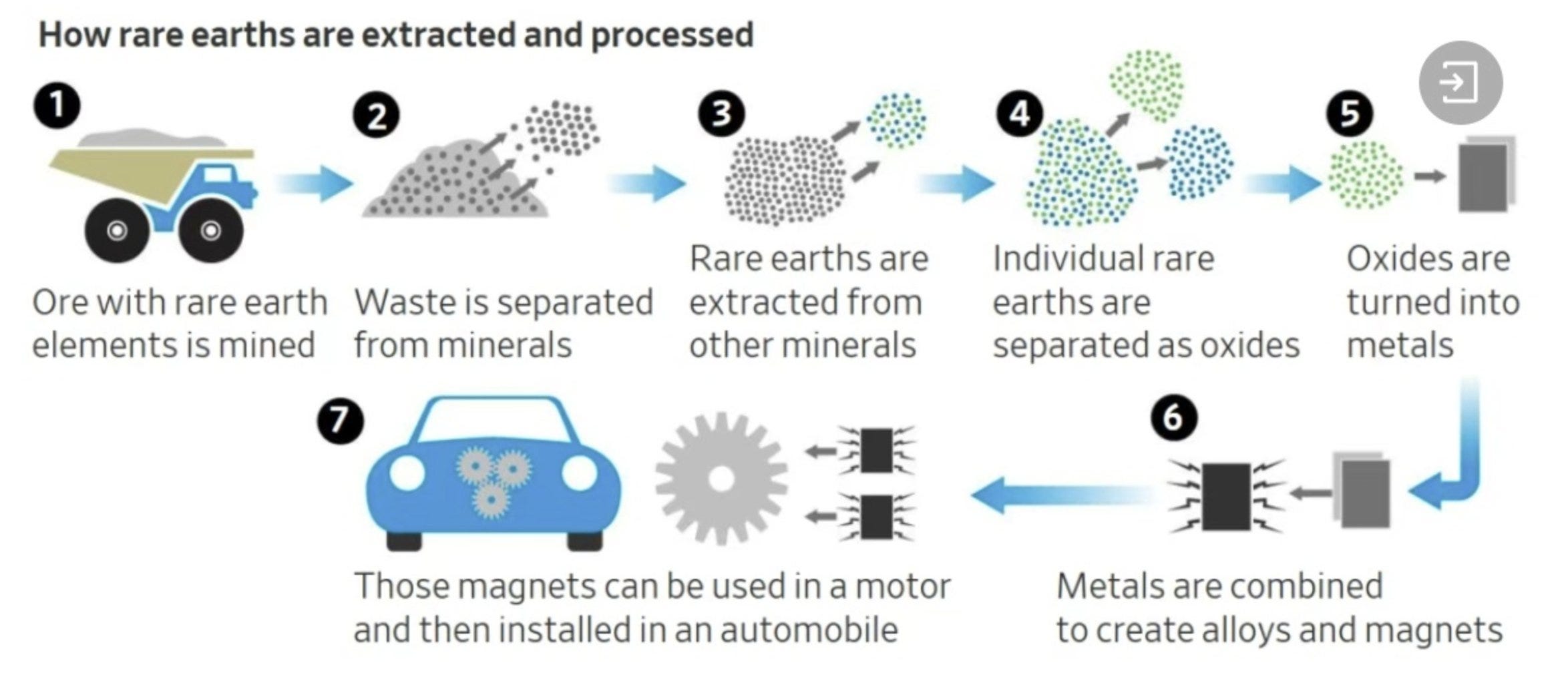
While more than 100 million metric tons of rare earth reserves exist globally (USGS, 2024), mining isn’t the bottleneck. The real constraint lies in processing these elements into usable oxides and metals. This involves complex solvent extraction and generates significant toxic waste, making it commercially viable in only a few parts of the world.
China began investing in processing infrastructure as early as the 1980s. Today, it has built a vertically integrated rare earths industry that dominates the global market:
-
99% of heavy rare earth processing capacity
-
95% of rare earth magnet production
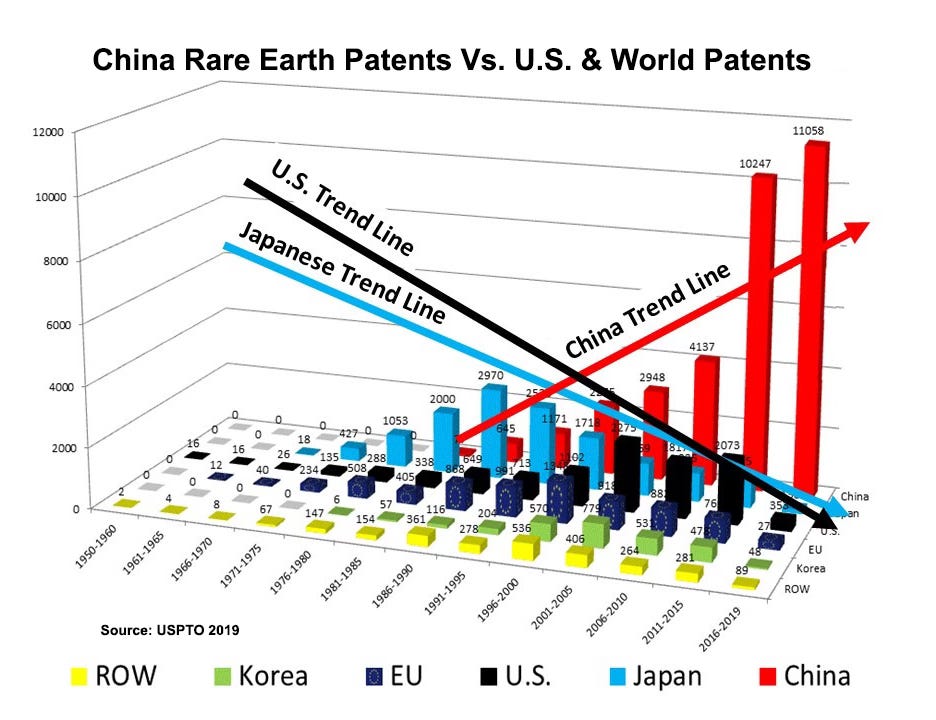
By 2020, China held over 60% of all rare earth-related patents, up from just 8% in 1990. This reflects a long term strategy to consolidate leadership in materials science and critical supply chains
A Geopolitical Achilles’ Heel
This concentration of processing power has become a strategic vulnerability. In 2023, China imposed export restrictions on gallium and germanium, raising fears that rare earths could be next. In response, India, the US, the EU, and Japan are all working to localize parts of the value chain.
In India, this risk has become real. In mid-2024, Foxconn’s AirPods manufacturing unit in Telangana faced onboarding delays due to restricted shipments of rare earth-based components, especially precision magnets used in speakers and haptics. China’s export license controls and customs slowdowns on neodymium-iron-boron (NdFeB) magnets disrupted the facility’s planned launch timeline. This underscores how even localized electronics manufacturing remains vulnerable to upstream bottlenecks from China.
At the same time, wind turbine OEMs reported delays in procuring the same magnets, impacting clean energy deployment across several projects (IEA Renewables Report, 2023).
India’s Strategic Shift: Bypassing the Magnet Monopoly
Recognizing this critical vulnerability, India has launched several strategic interventions:
-
Critical Minerals Mission (2023): 24 minerals, including REEs, designated as strategic. Auction of REE blocks in Andhra Pradesh and Jharkhand commenced (Ministry of Mines, 2024).
-
Partnerships for Processing: India signed an MoU with Australia to jointly develop REE processing tech and share metallurgical IP (MEAI, 2024).
-
PLI Scheme for EV Components: The latest PLI revision includes incentives for magnet-free motor architectures, including switched reluctance and axial flux motors (DPIIT, 2024).
At Artha99, our early recognition of this shift led us to back Avartan, a deep tech startup pioneering Switched Reluctance Motor (SRM) technology. Avartan is in the commercialization stage and is the second company globally, and the first in India, to commercialize SRM for high efficiency industrial and mobility applications. Its full stack solution eliminates the need for REE-based magnets, offering a robust and cost effective motor architecture that is inherently simpler to manufacture and localize at scale. For our detailed investment thesis on Avartan, check out our analysis here.
Question of the Month (Trivia)
Which candy company is also one of the world’s largest users of precision manufacturing molds?
A) Mars
B) Hershey’s
C) Haribo
D) Cadbury
The answer for the last newsletter’s question Which company is officially the world’s largest tire manufacturer by volume, producing over 300 million tires annually?
LEGO is officially recognized as the world’s largest tire manufacturer by volume, producing over 300 million small rubber tires annually for its toy vehicles. These are not full-sized car tires, but they still count in terms of unit production.
Hope you found the newsletter helpful! We’d love to hear your feedback and thoughts on the newsletter. If you’d like to connect or discuss anything further, feel free to reach out to us at pitch@artha99.vc or khushi@artha99.vc


